TICKFAW by Bill Evans
 |
 |
 |
 |
 |
The Tickfaw River is in dire need of a super-sized portion of TLC.
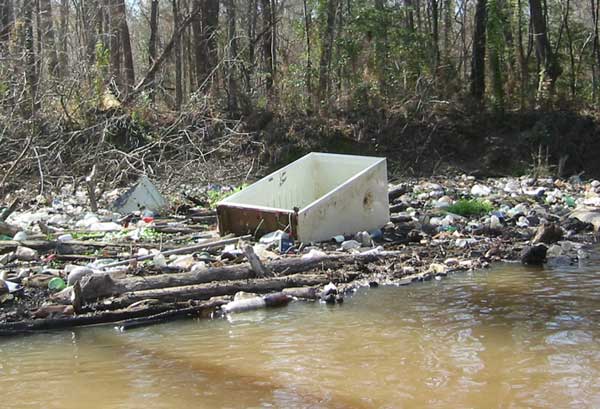
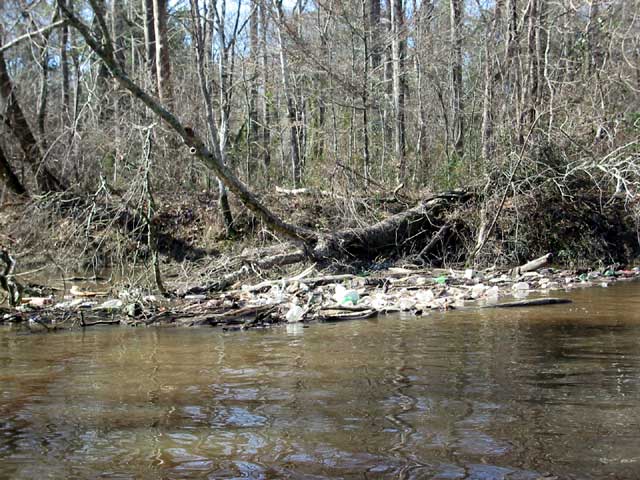
Over the portion from La. Hwy. 42 to the Tickfaw State Park lower landing, the Tickfaw has good paddling potential but much of it is a MESS!
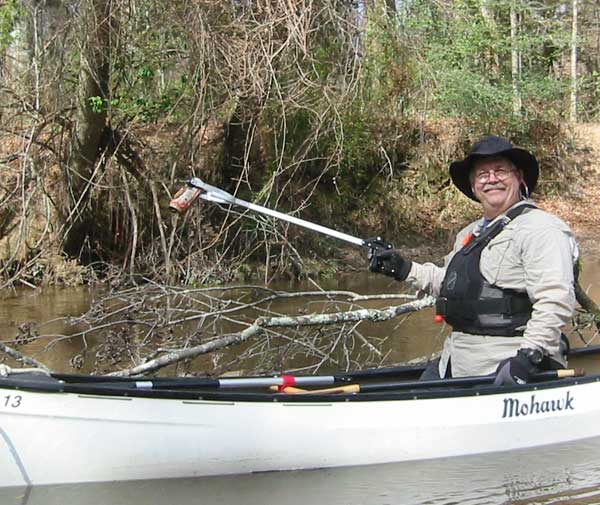
The stream is littered with enough plastic bottles if shredded and recycled to probably supply every club member with fleece for life, enough glass bottles to re-window One Shell Square, assorted metal containers, ice chests, dock floats, furniture, discarded tires, at least one whopper truck wheel and tire (mounted), various washing machine components and at least a half dozen refrigerators on a recent count. That’s for starters.
What would it take to clean out the mess? A LOT of bags, boats, dedicated paddlers and time. How long would this attractive stream remain sanitized? Probably not long, since it appears some folks may use it as their quick and easy, albeit down and dirty, personal dump.
Would the results be worth the time and effort? Possibly. It’s sad to see a stream with the Tickfaw’s potential in the shape it’s in, particularly in the worst reaches.
Should the Bayou Haystackers Paddling Club decide to “adopt” the river for period cleanups could we get help from any government agencies or other resources?
The section of the Tickfaw River from about a mile below La. 42 to Gum Bayou and the Tickfaw State Park is a nice, fairly wide, mostly deep stream and, at least on two recent paddles, relatively free of significant powerboat traffic. As spring and summer approach the gas-powered traffic may increase but at least for now it appears inconsequential.
The lower portion of this 7.4-mile reach is particularly attractive, with enough tree canopy to provide welcome summer months shade in many areas. Tickfaw State Park occupies land on both sides of the river, although the acreage on the west side is posted, said to be for a wildlife preserve. The parklands include many areas which appear ideal for camping, if park policies would allow primitive camping along the river banks.
Fortunately, most of the trash is clustered along the upper half to two-thirds of the route.
At about two feet on the Holden (La.) gage, the Tickfaw has enough flow for a nice, leisurely paddle in a tranquil wilderness setting over practically this entire route.
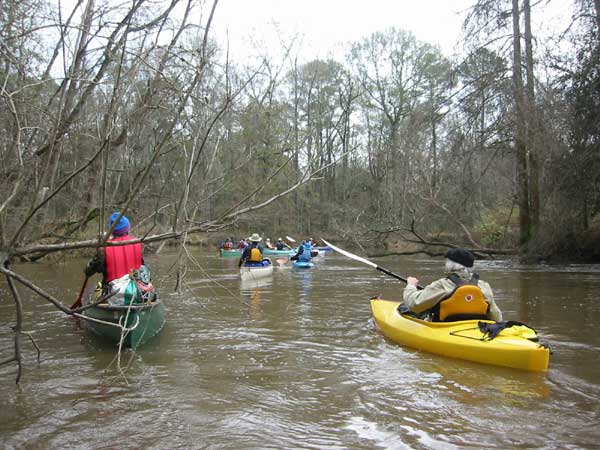
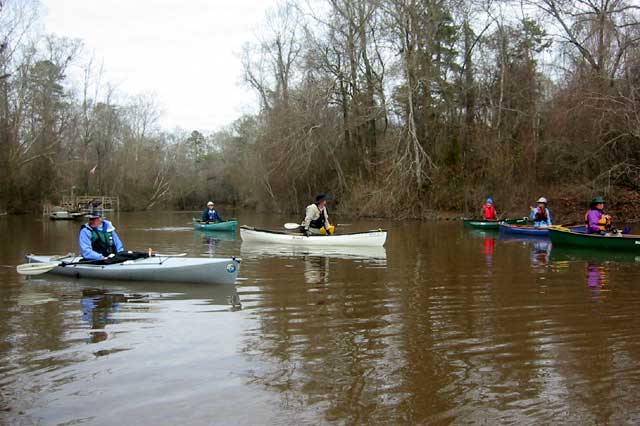
On January 31, Ruby Ackerson, Tom Dumas, Martina Ellis, Bill Evans, Ann and Bill Hager, Nancy Hall, Steve Landry, Scott Peterson, Darryl Pry, Hulin Robert, Walter Tabary and Joyce Tracey paddled the Tickfaw from J & W Campground south of Hwy. 42 to the Gum Bayou takeout at Tickfaw State Park.
The consensus was that river cleanup would be a daunting task, but the stream is probably worth the effort. BHPC environmental chairman Jed Pitre is investigating what would be required for our club to “adopt” the Tickfaw, including what if any assistance could be obtained from government agencies.
The Bayou Haystackers library expanded significantly in recent months with donations from members Ann and Bill Hager and Darryl Pry, along with a new video acquisition from the Louisiana Department of Natural Resources.
 Bill
and Ann donated the following books:
Bill
and Ann donated the following books:
- American Red Cross CPR Instructor’s Manual;
- American Red Cross Standard First Aid;
- Backpacking, A Complete Guide—Jack McDowell;
- Behavior Kinesiology—John Diamond;
- Canoe Trails of the Deep South—Chuck Estes, Elizabeth F. Carter & Byron Almquist;
- Canoer’s Bible, The—Robert Douglas Mead/J. Wayne Fears;
- Canoer’s Bible, The—Robert Douglas Mead;
- River Safety Report 1992-1995—Charlie Walbridge, American Canoe Assoc.;
- River Safety Report 1989-1991—Charlie Walbridge, American Canoe Assoc.;
- River Trails, Bayous & Backroads—Louisiana Office of Tourism;
- Taking the Ocoee Challenge—Ron Clayton;
- Texas Rivers & Rapids, Canoe & Backpack Guide Book, Vol. IV—Narramore, Nolen;
- Texas Rivers & Rapids, Canoe & Backpack Guide Book, Vol. VII—Narramore, Nolen;
- U.S. Outdoor Atlas & Recreation Guide—John Oliver Jones;
- White Water Kayaking—Ray Rowe; and
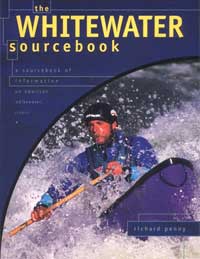
- Whitewater Sourcebook—Richard Penny.
The Hagers also donated these videos:
- Middle Fork of the Salmon River, Idaho;
- River of Lost Souls, Upper Animas, Colo.; and
- Riverscapes, Rivers of the West.
Darryl donated the video Path of the Paddle, Quiet Water by Bill Mason to our collection.
"Disappearing Wetlands of Louisiana," a Turner South production for the Louisiana Department of Natural Resources, is a 30-minute documentary about coastal Louisiana, our alarming rate of wetlands loss and associated threats to residents, wildlife and commerce. The video was scheduled to be aired statewide on Louisiana Public Broadcasting stations March 2.
BHPC library books
and videos will be available for checkout by club members at General Membership
and Executive Committee meetings.